Table of Contents
- The Evolution of Social Engineering
- —From Nigerian Princes to Neural Networks
- —The Numbers Are Alarming
- Understanding Deepfake Technology
- —How Deepfakes Work
- —The Weaponization of Synthetic Media
- The Psychology Behind Social Engineering
- —1. Authority Bias
- —2. Urgency and Scarcity
- —3. Social Proof
- —4. Reciprocity
- —5. Familiarity and Trust
- Defense Strategies for Individuals
- —1. Establish Verification Protocols
- —2. Develop a "Pause Before Acting" Habit
- —3. Strengthen Your Authentication
- —4. Limit Your Digital Footprint
- Defense Strategies for Organizations
- —1. Implement Out-of-Band Verification
- —2. Deploy AI-Powered Detection
- —3. Conduct Regular Security Awareness Training
- —4. Establish a "No Secrets via Voice" Policy
- Detecting Deepfakes
- —Visual Indicators
- —Audio Indicators
- —Behavioral Indicators
- —Technical Verification
- The Connection to Password Security
- Looking Ahead
- Conclusion
Social Engineering and Deepfake Threats: The Ultimate Defense Guide
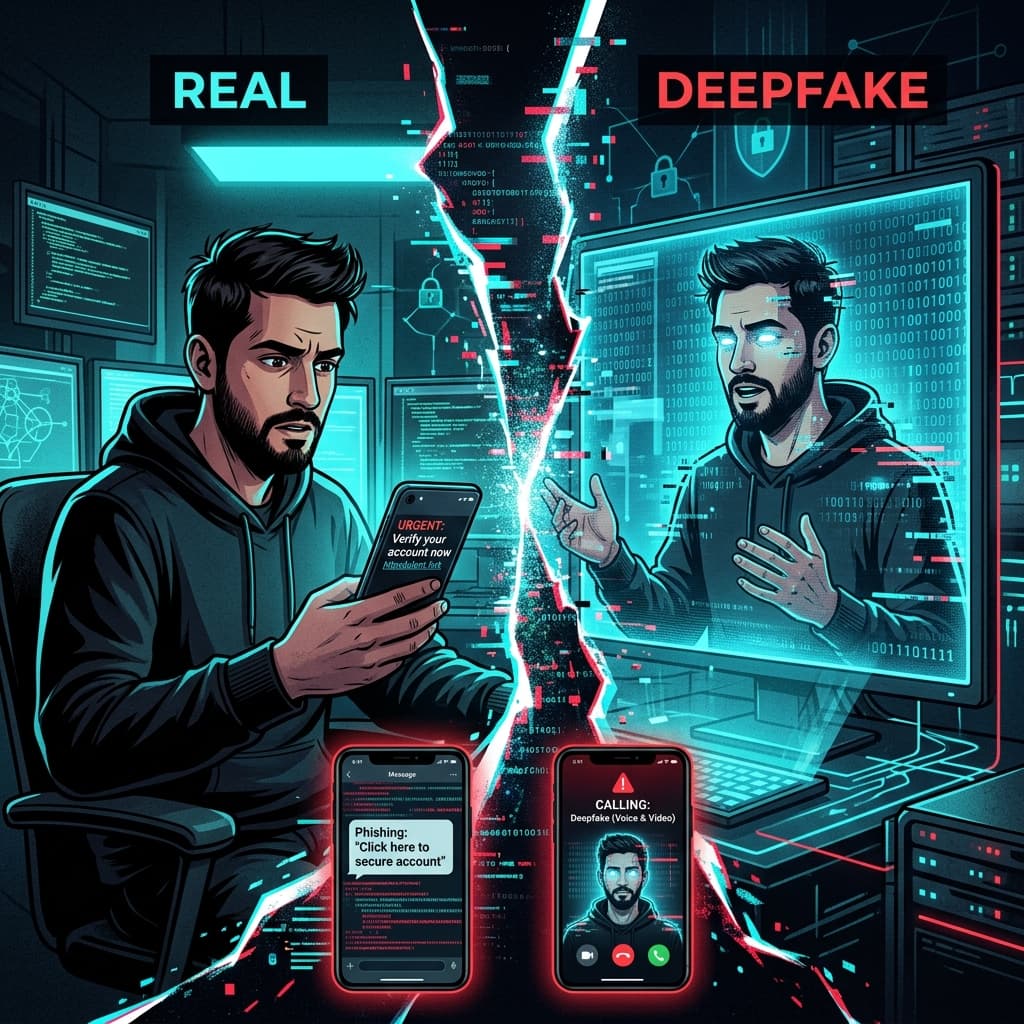
The most sophisticated firewall in the world cannot protect you from a well-crafted social engineering attack. Why? Because the target isn't your network — it's your brain. And in the age of generative AI, attackers now wield tools that can clone voices, fabricate video calls, and craft hyper-personalized phishing messages at a scale that was unimaginable just two years ago.
Social engineering has always been the most effective attack vector in cybersecurity. But the fusion of AI-powered deepfakes with traditional psychological manipulation has created a threat landscape that demands an entirely new defense paradigm.
The Evolution of Social Engineering
From Nigerian Princes to Neural Networks
The early days of social engineering were crude — mass-emailed scams with obvious grammatical errors targeting the most gullible recipients. Today's attacks are surgical:
- Hyper-personalized: Attackers use scraped LinkedIn profiles, public social media posts, and leaked databases to craft messages that reference real projects, colleagues, and company events
- Multi-channel: A single attack might combine a spoofed email, a follow-up phone call using a cloned voice, and a fake video message — all coordinated to build credibility
- AI-generated: Large language models produce grammatically perfect, contextually appropriate messages in any language, eliminating the traditional red flags
The Numbers Are Alarming
According to the FBI's Internet Crime Complaint Center (IC3), social engineering attacks caused over $12.5 billion in losses in the past year alone. Business Email Compromise (BEC) remains the single most costly category of cybercrime.
Understanding Deepfake Technology
How Deepfakes Work
Deepfakes use deep learning neural networks — specifically Generative Adversarial Networks (GANs) and diffusion models — to create synthetic media that is virtually indistinguishable from reality.
Voice Cloning: Modern voice synthesis models can clone a person's voice from as little as 3 seconds of audio. The resulting synthetic voice captures accent, intonation, speaking rhythm, and emotional tone.
Video Deepfakes: Face-swapping and full-body synthesis can generate realistic video of a person saying or doing things they never did. Real-time deepfake technology now enables live video calls with a synthetic face.
Text Generation: LLMs can analyze a person's writing style from emails, social media posts, and documents, then generate new messages that match their vocabulary, tone, and communication patterns.
The Weaponization of Synthetic Media
Attackers are using deepfakes for:
- CEO Fraud: Calling a CFO with a cloned voice of the CEO, instructing an urgent wire transfer
- IT Impersonation: Video-calling employees as "IT support" to extract credentials or install remote access tools
- Vendor Compromise: Sending invoices via email that appear to come from legitimate vendors, with deepfake voice confirmation when questioned
- Recruitment Scams: Conducting fake job interviews via deepfake video to extract personal information and identity documents
- Blackmail: Creating fabricated compromising content to extort individuals
The Psychology Behind Social Engineering
Understanding why these attacks work is essential to defending against them. Attackers exploit fundamental human psychological traits:
1. Authority Bias
We tend to comply with requests from authority figures without questioning them. When your "CEO" calls with an urgent request, your instinct is to help — not to verify.
2. Urgency and Scarcity
"This must be done in the next 30 minutes or we'll lose the deal." Creating artificial time pressure bypasses rational decision-making.
3. Social Proof
"Everyone on the team has already updated their credentials through this link." If others have supposedly done it, it must be safe.
4. Reciprocity
"I just helped you with that project issue — could you quickly approve this invoice?" Creating a sense of obligation.
5. Familiarity and Trust
Using insider knowledge (names, projects, internal jargon) to establish credibility. The more the attacker "knows," the more you trust them.
Defense Strategies for Individuals
1. Establish Verification Protocols
Never take high-stakes actions based solely on a single communication channel:
- Financial transactions: Always verify through a known, pre-established channel (call back on a number you already have, not the one in the message)
- Credential changes: Navigate to the service directly — never click links in emails or messages
- Access requests: Confirm through your organization's official ticketing system
2. Develop a "Pause Before Acting" Habit
The most effective defense against urgency-based attacks is simply slowing down. If a request creates pressure to act immediately, that pressure itself should be a red flag.
Ask yourself:
- Would this person normally make this type of request?
- Does the communication channel match how they usually contact me?
- Can I verify this through an independent channel before acting?
3. Strengthen Your Authentication
Social engineering often targets credentials as its end goal. Make your credentials resistant to compromise:
- Use passkeys wherever available — they're immune to phishing
- Enable hardware security keys for critical accounts
- Generate unique, high-entropy passwords with a secure password generator for every account
- Never share passwords, OTPs, or security codes with anyone — legitimate services will never ask for them
- Review our guide on multi-factor authentication for comprehensive protection
4. Limit Your Digital Footprint
Every piece of personal information you share publicly is potential ammunition for social engineers:
- Audit your social media privacy settings quarterly
- Be cautious about sharing organizational details, travel plans, and daily routines
- Consider what information your LinkedIn profile reveals to attackers
Defense Strategies for Organizations
1. Implement Out-of-Band Verification
Establish mandatory verification procedures for sensitive actions:
- Financial: Any transaction above a threshold requires verification via a separate, pre-registered communication channel
- IT Changes: Password resets, MFA changes, and access grants require in-person or video verification with identity confirmation
- Vendor Payments: New vendor bank details must be confirmed through the vendor's established primary contact
2. Deploy AI-Powered Detection
Fight AI with AI:
- Email security gateways with NLP analysis to detect AI-generated phishing content
- Voice authentication systems that can detect synthetic speech patterns
- Content provenance tools that verify the authenticity of media using C2PA standards
- Behavioral analytics that flag unusual communication patterns (e.g., a CEO sending urgent financial requests at 3 AM)
3. Conduct Regular Security Awareness Training
Training must evolve beyond annual compliance checkboxes:
- Simulated phishing campaigns that include AI-generated content
- Deepfake awareness workshops with live demonstrations
- Social engineering "red team" exercises where authorized testers attempt real-world manipulation
- Incident reporting culture where employees are rewarded (not punished) for reporting suspicious activity
4. Establish a "No Secrets via Voice" Policy
Given the maturity of voice cloning technology, organizations should implement strict policies:
- Never share credentials, codes, or sensitive information over phone calls
- Never change security settings based on voice or video instructions alone
- All security-relevant changes must go through authenticated, auditable systems
Detecting Deepfakes
While deepfakes are increasingly sophisticated, they're not yet perfect. Current detection methods include:
Visual Indicators
- Unnatural blinking patterns or eye movements
- Inconsistent lighting or shadows on the face
- Slight distortion at the edges of the face (especially around hair)
- Mismatch between lip movements and audio
Audio Indicators
- Subtle robotic or "too perfect" quality in voice calls
- Inconsistent background noise or acoustic environment
- Unusual pauses or breathing patterns
Behavioral Indicators
- Communication style that doesn't quite match the person's normal patterns
- Reluctance to deviate from a "script" or answer unexpected questions
- Unusual requests that fall outside normal business procedures
Technical Verification
- C2PA provenance checks for images and videos
- Voice biometric analysis tools that compare against known samples
- Metadata analysis of media files for signs of synthetic generation
The Connection to Password Security
Social engineering attacks frequently target passwords and authentication credentials. A comprehensive defense strategy must include:
- Cryptographically strong, unique passwords for every account — generated with tools like SecureGen, not created by humans
- Phishing-resistant MFA (hardware keys or passkeys) that cannot be bypassed even if an attacker successfully social-engineers a password
- Password manager adoption to eliminate the need to remember or type passwords, reducing exposure to keyloggers and shoulder surfing
- Regular credential audits to identify and rotate any compromised passwords using breach monitoring services
- Understanding of common password mistakes that social engineers exploit
Looking Ahead
The arms race between deepfake technology and detection tools will intensify. Key developments to watch:
- Real-time deepfake detection integrated directly into video conferencing platforms
- Cryptographic identity verification becoming standard for business communications
- Regulatory frameworks requiring disclosure of AI-generated content in commercial and political contexts
- Hardware-based authentication that provides mathematical proof of identity, independent of biometrics that can be faked
Conclusion
Social engineering exploits the one vulnerability that no software patch can fix: human psychology. The addition of AI-powered deepfakes has made these attacks more convincing and harder to detect than ever before.
But defense is possible. By combining technological safeguards (AI detection, phishing-resistant authentication, zero-trust architecture) with human awareness training and organizational policies, you can build a resilient defense against even the most sophisticated social engineering campaigns.
The best defense isn't just technology — it's a culture of healthy skepticism, verification, and security awareness. In the age of synthetic media, trust must be earned through cryptographic proof, not assumed through familiarity.
Tags
Fact Checked by SecureGen Editorial Team
Authenticity Disclosure: This article was drafted with the assistance of AI tools for structural research. It was subsequently rigorously fact-checked, edited, and expanded by our Security Editorial Team to guarantee technical accuracy and alignment with modern cryptographic standards.
Author
SecureGen Team
Cybersecurity Expert & Developer
SecureGen Team is a dedicated security researcher focused on privacy-centric tools and cryptography. They write to educate users on protecting their digital identities with strong, client-side encryption and modern Web Crypto API standards.
Frequently Asked Questions
QWhat is this blog post about?
AI-powered deepfakes and advanced social engineering are redefining cyber threats. Learn how attackers use synthetic voices, fake videos, and psychological manipulation — plus proven strategies to protect yourself and your organization.
QHow long does it take to read this article?
This article requires approximately 15 min read to read completely.
QWho authored this blog post?
This article was written by SecureGen Team, an expert in password security and cybersecurity best practices.
QIs this information up to date?
Yes, this article was published on June 10, 2026 and contains current information about password security practices.