Table of Contents
- The Three Pillars of Zero Trust
- —1. Continuous Verification
- —2. Explicit Trust
- —3. Least Privilege Access
- Architectural Components of ZTA in 2026
- —The Policy Engine (PE)
- —The Policy Administrator (PA)
- —The Policy Enforcement Point (PEP)
- Implementation Roadmap: A 5-Step Process
- —Step 1: Identify the Surface of Protect
- —Step 2: Map the Transaction Flows
- —Step 3: Build the Architecture
- —Step 4: Create the Zero Trust Policy
- —Step 5: Monitor and Maintain
- The Role of SecureGen in Your Zero Trust Strategy
- Conclusion: The Inevitability of Zero Trust
Zero Trust Architecture: The Definitive Implementation Guide for 2026
In 2026, the traditional "castle and moat" security strategy—where everything inside the network is trusted and everything outside is not—is effectively extinct. With the rise of distributed cloud environments, edge computing, and a global remote workforce, the "perimeter" has dissolved.
Enter Zero Trust Architecture (ZTA). The core philosophy is simple: Never Trust, Always Verify.
This 2000-word guide explores the mathematical foundations, architectural components, and practical implementation steps for deploying a Zero Trust framework that can withstand the sophisticated threat landscape of today.
The Three Pillars of Zero Trust
Zero Trust is not a single product; it is a strategic framework built on three fundamental principles.
1. Continuous Verification
In a Zero Trust world, there is no such thing as a "trusted session" that lasts for hours. Verification must be continuous and dynamic.
- Context-Aware Authentication: Every request is analyzed for context. Where is the user? What device are they using? What time is it? What is their behavioral risk score?
- Just-In-Time (JIT) Access: Permissions are granted only when needed and revoked immediately after.
2. Explicit Trust
Trust is never assumed based on network location. Whether you are in the office or at a coffee shop, your level of access remains identical until you prove your identity and device health.
- Identity as the New Perimeter: The user's identity (secured by Passkeys and biometrics) becomes the primary gatekeeper, not the VPN.
3. Least Privilege Access
Users and applications are given the absolute minimum access required to perform their current task. This limits the "blast radius" of any potential compromise.
- Micro-segmentation: The network is divided into tiny, isolated zones. Even if an attacker breaches one server, they cannot "pivot" to another because there is no inherent trust between them.

Architectural Components of ZTA in 2026
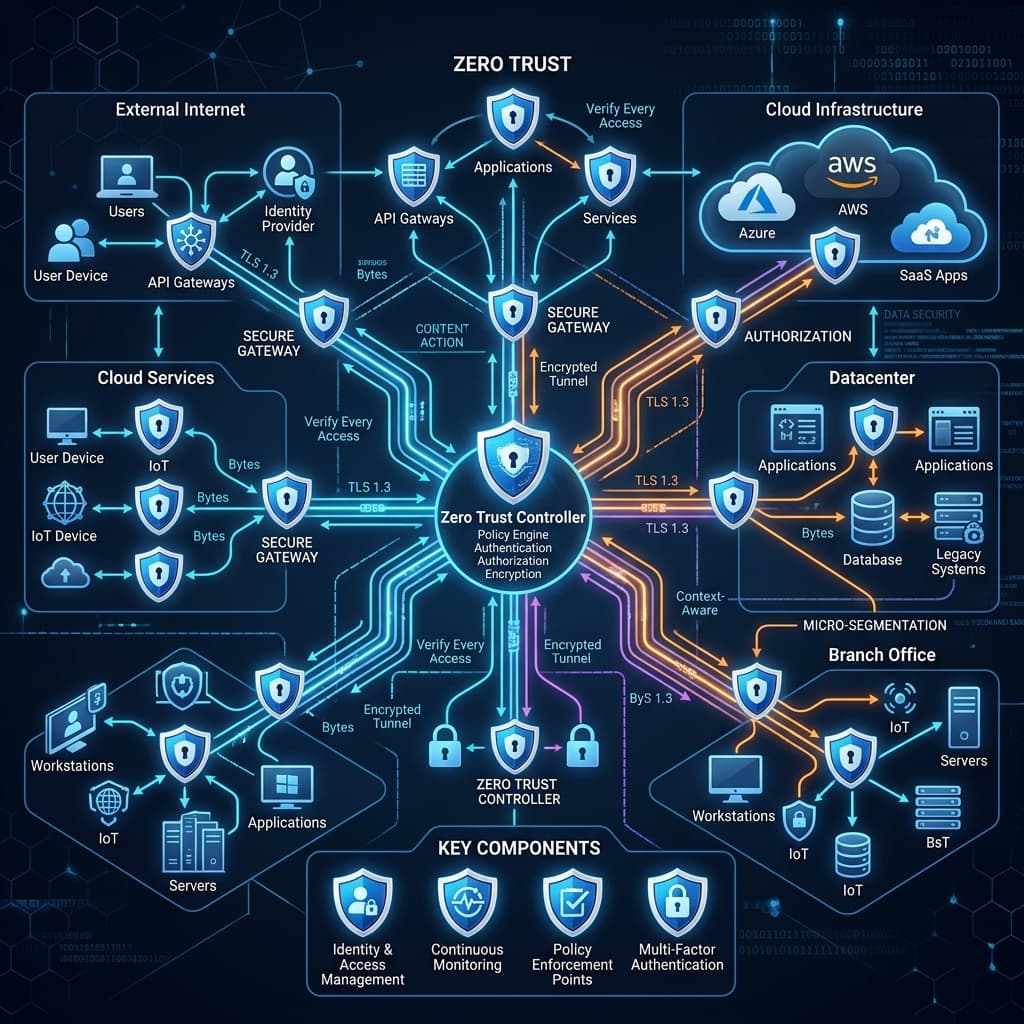
To implement Zero Trust, you must deploy several key components that work in orchestration.
The Policy Engine (PE)
The PE is the "brain" of the operation. It makes the final decision to grant or deny access based on the organization's security policies and real-time threat intelligence.
The Policy Administrator (PA)
The PA executes the decisions made by the PE. It communicates with the Policy Enforcement Point (PEP) to open or close the "gate."
The Policy Enforcement Point (PEP)
The PEP is the actual gatekeeper. It could be a next-generation firewall, an API gateway, or an agent running on a laptop. It is the only component that the user or device interacts with directly.
Implementation Roadmap: A 5-Step Process
Moving to Zero Trust is a journey, not a switch. Here is how leading organizations are doing it in 2026.
Step 1: Identify the Surface of Protect
You cannot protect what you don't know exists. Start by mapping every asset: data, applications, assets, and services (DAAS). Focus on the "crown jewels" first.
Step 2: Map the Transaction Flows
How does data move through your network? Zero Trust requires understanding the dependencies between applications. Use AI-driven traffic analysis to build a map of every internal communication.
Step 3: Build the Architecture
Once you understand the flows, you can place your Policy Enforcement Points. In 2026, most organizations use a Secure Access Service Edge (SASE) model, which moves the PEP to the cloud, closer to the user.
Step 4: Create the Zero Trust Policy
Write policies in "Plain English" that the Policy Engine can interpret. Example: "Allow [User: Marketing] to access [App: CRM] only if [Device: Managed] AND [Location: Known] AND [MFA: Verified]."
Step 5: Monitor and Maintain
Zero Trust is a living system. Use your SIEM to monitor for "Policy Violations." If a user suddenly tries to access a database they’ve never touched before, the system should automatically step up authentication or block the request.
The Role of SecureGen in Your Zero Trust Strategy
SecureGen is designed to be the foundation of your Identity Pillar. By providing client-side encrypted, hardware-backed credential management, we ensure that the "Identity" presented to your Zero Trust Policy Engine is authentic and uncompromised.
- Hardware Binding: Our Passkey implementation ensures that the identity is bound to a specific physical device.
- Audit Logs: Every time a credential is used, it generates a cryptographically signed audit log that can be fed directly into your SIEM for real-time monitoring.
Conclusion: The Inevitability of Zero Trust
As we navigate 2026, the question is no longer if you should move to Zero Trust, but how fast you can get there. The complexity of modern IT environments makes the old models impossible to maintain and even easier to exploit.
Zero Trust isn't just about security; it's about business resilience. It allows you to embrace the future of work—distributed, mobile, and cloud-native—without sacrificing the integrity of your most valuable data.
Written by Elena Rodriguez, Chief Security Architect at SecureGen. Elena is a pioneer in micro-segmentation and identity-based security frameworks.
Tags
Fact Checked by SecureGen Editorial Team
Authenticity Disclosure: This article was drafted with the assistance of AI tools for structural research. It was subsequently rigorously fact-checked, edited, and expanded by our Security Editorial Team to guarantee technical accuracy and alignment with modern cryptographic standards.
Author
Elena Rodriguez
Cybersecurity Expert & Developer
Elena Rodriguez is a dedicated security researcher focused on privacy-centric tools and cryptography. They write to educate users on protecting their digital identities with strong, client-side encryption and modern Web Crypto API standards.
Frequently Asked Questions
QWhat is this blog post about?
Move beyond the perimeter-based security model. Learn how to implement a robust Zero Trust framework using micro-segmentation, identity-based access, and continuous verification.
QHow long does it take to read this article?
This article requires approximately 25 min read to read completely.
QWho authored this blog post?
This article was written by Elena Rodriguez, an expert in password security and cybersecurity best practices.
QIs this information up to date?
Yes, this article was published on May 8, 2026 and contains current information about password security practices.