Table of Contents
- Understanding the Attack Surface
- —The Dependency Problem
- —Types of Supply Chain Attacks
- Real-World Impact
- —The Scale of the Problem
- —Notable Incidents
- Defense Strategies
- —1. Implement Software Bill of Materials (SBOM)
- —2. Enable Dependency Lockfiles and Pinning
- —3. Use Private Registries with Namespace Scoping
- —4. Automated Vulnerability Scanning
- —5. Code Signing and Provenance Verification
- —6. Principle of Least Privilege for CI/CD
- Credential Security in the Supply Chain
- —Best Practices
- Building a Supply Chain Security Program
- —For Development Teams
- —For Security Teams
- —For Leadership
- The Role of AI in Supply Chain Defense
- Conclusion
Software Supply Chain Attacks: How to Defend Your Development Pipeline
In the first half of 2026, supply chain compromises have surpassed phishing as the most costly attack vector for organizations worldwide. The reason is simple: why attack one company directly when you can compromise a single widely-used dependency and simultaneously infiltrate thousands of targets?
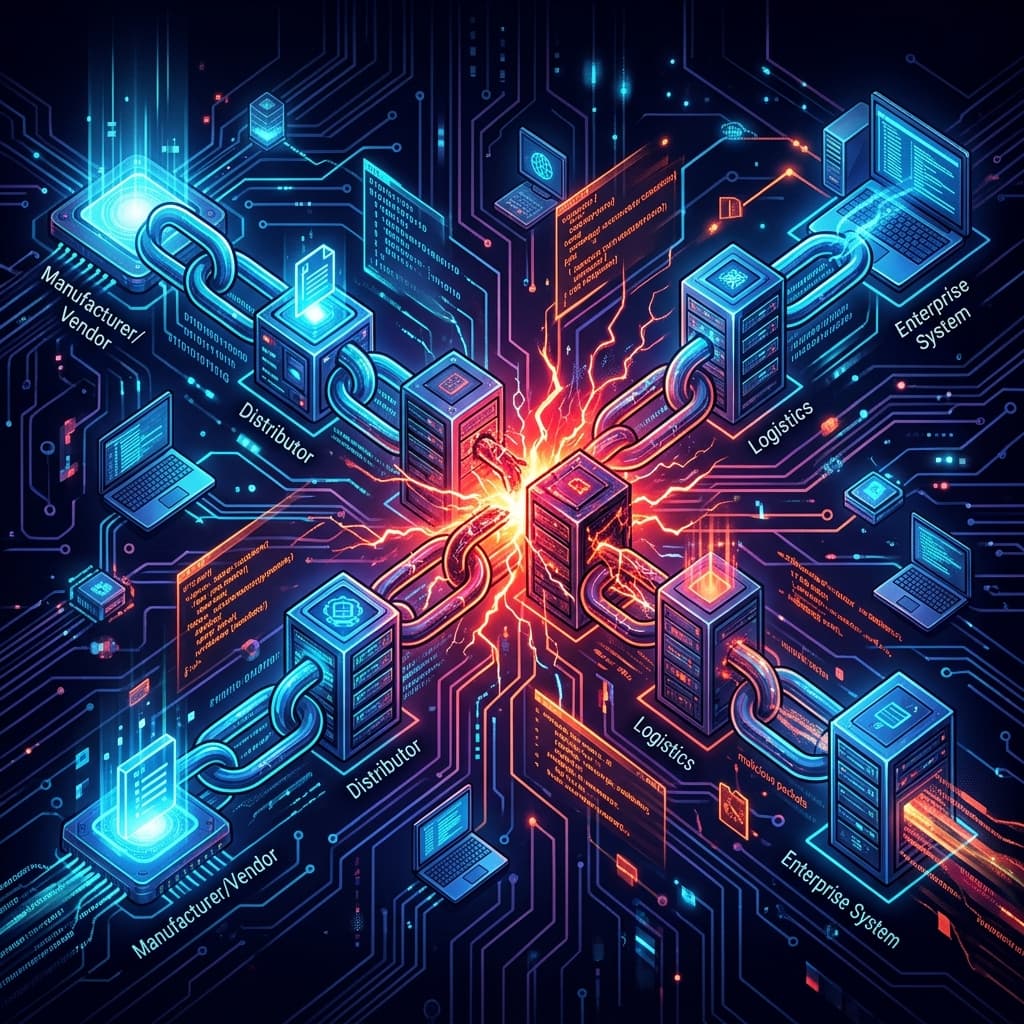
From the SolarWinds breach that shook the industry to the ongoing wave of malicious npm and PyPI packages, attackers have discovered that the weakest point in modern software isn't the application itself — it's the invisible chain of dependencies, tools, and services that power it.
Understanding the Attack Surface
Modern software applications don't exist in isolation. A typical web application pulls in hundreds to thousands of third-party dependencies, each of which is maintained by independent developers or organizations with varying security practices.
The Dependency Problem
Consider a simple Node.js project. When you run npm install, you might directly depend on 20 packages. But those 20 packages have their own dependencies, which have their own dependencies. The resulting dependency tree can easily contain 1,500+ packages — most of which you've never audited.
Each package represents:
- A potential injection point for malicious code
- A maintainer account that could be compromised
- A build system that could be tampered with
- A distribution channel that could be hijacked
Types of Supply Chain Attacks
1. Dependency Confusion (Namespace Hijacking) Attackers register public packages with names matching private internal packages. When a misconfigured build system resolves the dependency, it pulls the malicious public version instead of the private one.
2. Typosquatting
Creating packages with names similar to popular ones (lodash vs 1odash, react-dom vs reactdom). Developers who make a typo in their package.json inadvertently install malware.
3. Account Takeover Compromising the npm/PyPI/GitHub account of a legitimate package maintainer, then pushing a malicious update to the existing package. All downstream users receive the compromised version automatically.
4. Build System Compromise Injecting malicious code into CI/CD pipelines, Docker base images, or build toolchains. The output artifacts contain malware even though the source code appears clean.
5. Protestware Legitimate maintainers intentionally adding destructive or political code to their own packages — a trend that has accelerated in recent years.
Real-World Impact
The Scale of the Problem
According to Sonatype's 2026 State of the Software Supply Chain report:
- Over 700,000 malicious packages were identified across major registries in the past 12 months
- The average enterprise application contains 147 dependencies with known vulnerabilities
- 62% of organizations experienced at least one supply chain-related security incident
Notable Incidents
The consequences of supply chain attacks extend far beyond code injection. Compromised build pipelines have led to:
- Data exfiltration: Stolen credentials, API keys, and customer data
- Cryptomining: Hijacked build servers used for cryptocurrency mining
- Ransomware deployment: Malicious updates that deploy ransomware to end users
- Espionage: State-sponsored actors using compromised dependencies for long-term surveillance
Defense Strategies
1. Implement Software Bill of Materials (SBOM)
An SBOM is a comprehensive inventory of every component in your software. Think of it as a nutritional label for your codebase. It lists:
- Every direct and transitive dependency
- Version numbers and sources
- Known vulnerabilities (CVEs)
- License information
Tools: SPDX, CycloneDX, Syft, Grype
2. Enable Dependency Lockfiles and Pinning
Always commit your lockfiles (package-lock.json, yarn.lock, Pipfile.lock). These ensure that builds are reproducible and prevent unexpected version changes.
Go further with hash verification: lockfiles can store cryptographic hashes of each package, ensuring that what you download matches what was published.
3. Use Private Registries with Namespace Scoping
Host an internal package registry (Artifactory, Verdaccio, GitHub Packages) and configure your build system to resolve internal packages from this private source first. This eliminates dependency confusion attacks entirely.
4. Automated Vulnerability Scanning
Integrate dependency scanning into your CI/CD pipeline:
- Snyk, Dependabot, or Renovate for automated dependency updates
- OWASP Dependency-Check for known CVE detection
- Socket.dev for behavioral analysis of npm packages (detecting obfuscated code, network calls, filesystem access)
5. Code Signing and Provenance Verification
Verify that packages come from trusted sources:
- Sigstore/cosign for container image signing
- npm provenance for verifying that a package was built from a specific commit in a public repository
- SLSA (Supply-chain Levels for Software Artifacts) framework for assessing build integrity
6. Principle of Least Privilege for CI/CD
Your CI/CD pipeline should operate with minimal permissions:
- Separate build and deploy credentials
- Use short-lived tokens instead of long-lived secrets
- Restrict which steps can access production credentials
- Audit all pipeline modifications
Credential Security in the Supply Chain
A critical but often overlooked aspect of supply chain security is credential management. Leaked API keys, database passwords, and service tokens in source code or CI/CD configurations are a primary entry point for attackers.
Best Practices
- Never hardcode secrets in source code, Docker files, or CI/CD configurations
- Use environment variables and secrets managers (HashiCorp Vault, AWS Secrets Manager)
- Generate all service passwords with a cryptographically secure generator — avoid predictable or shared passwords across environments
- Rotate credentials automatically on a regular schedule
- Implement zero-trust architecture principles for service-to-service authentication
- Ensure all team members understand password security fundamentals — a single compromised developer credential can cascade through the entire supply chain
Building a Supply Chain Security Program
For Development Teams
- Adopt an "assume breach" mentality — treat every dependency as potentially compromised
- Review dependency updates manually for critical packages before merging automated PRs
- Minimize your dependency footprint — every package you add increases your attack surface
- Subscribe to security advisories for your key dependencies
For Security Teams
- Establish an SBOM requirement for all production deployments
- Create a vendor security assessment process for third-party services
- Monitor for anomalous package behavior using behavioral analysis tools
- Conduct regular supply chain threat modeling exercises
- Implement incident response playbooks specific to supply chain compromises
For Leadership
- Allocate budget for supply chain security tooling — it's no longer optional
- Require SLSA Level 2+ compliance for critical systems
- Include supply chain risk in your overall cybersecurity strategy
- Engage with the open-source community — contributing to the security of your dependencies benefits everyone
The Role of AI in Supply Chain Defense
Machine learning models are increasingly being deployed to detect supply chain threats:
- Behavioral analysis: AI can flag packages that exhibit suspicious behavior (unexpected network calls, filesystem access, environment variable reading) even when the code is heavily obfuscated
- Anomaly detection: Identifying unusual patterns in package updates, maintainer changes, or download spikes
- Automated code review: LLM-powered tools that can summarize what a dependency update actually changes in plain language
However, as we've explored in our analysis of AI-driven security threats, attackers are also leveraging AI to create more sophisticated supply chain attacks — generating malicious code that evades static analysis tools.
Conclusion
Software supply chain security is no longer a niche concern for security researchers — it's a fundamental requirement for every organization that writes or deploys software. The attack surface is vast, the consequences are severe, and the threat is accelerating.
By implementing SBOM tracking, dependency scanning, code signing, and the principle of least privilege, you can dramatically reduce your exposure to supply chain attacks. Combined with strong credential management practices and a culture of security awareness, your development pipeline can become a fortress rather than a vulnerability.
The software you build is only as secure as its weakest dependency. Make sure that dependency isn't the one you never audited.
Tags
Fact Checked by SecureGen Editorial Team
Authenticity Disclosure: This article was drafted with the assistance of AI tools for structural research. It was subsequently rigorously fact-checked, edited, and expanded by our Security Editorial Team to guarantee technical accuracy and alignment with modern cryptographic standards.
Author
SecureGen Team
Cybersecurity Expert & Developer
SecureGen Team is a dedicated security researcher focused on privacy-centric tools and cryptography. They write to educate users on protecting their digital identities with strong, client-side encryption and modern Web Crypto API standards.
Frequently Asked Questions
QWhat is this blog post about?
Supply chain attacks are now the #1 threat vector for organizations. Learn how compromised dependencies, malicious packages, and CI/CD pipeline exploits work — and the defense strategies to stop them.
QHow long does it take to read this article?
This article requires approximately 16 min read to read completely.
QWho authored this blog post?
This article was written by SecureGen Team, an expert in password security and cybersecurity best practices.
QIs this information up to date?
Yes, this article was published on June 12, 2026 and contains current information about password security practices.